I think many founders have faced the challenge of finding a co-founder for their project. Most projects either never get off the ground or fail because the founder can’t find a capable co-founder.
Let me share my perspective on the key reasons behind this problem.
All people are different. And often, very different. What misleads us is a certain superficial similarity: most people have two arms, two legs, a body, and a head. That’s where the similarity ends. :)
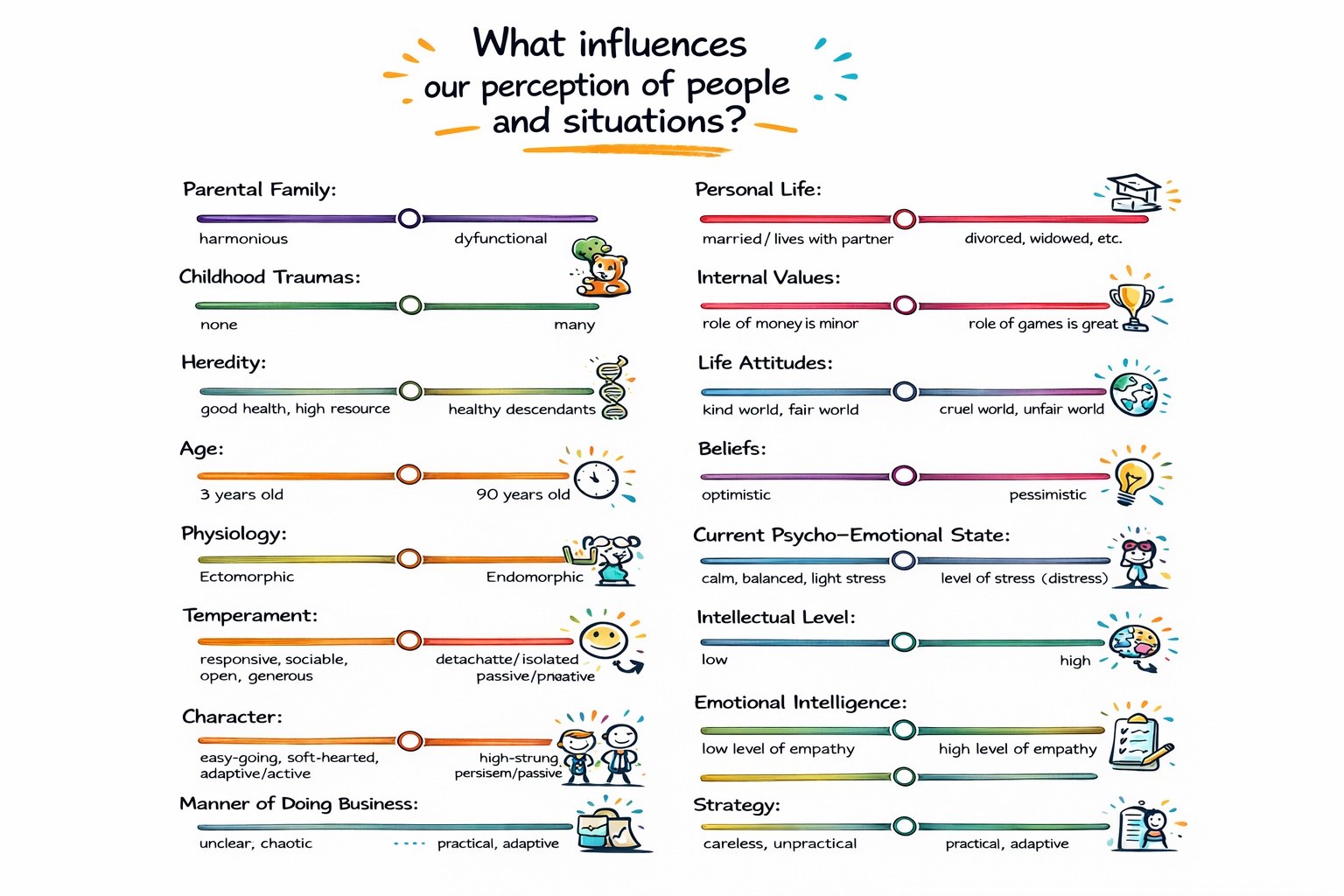
Everything a person sees, hears, or learns passes through their internal filters of perception. The settings of these filters are shaped by a huge number of factors — gender, age, health, family environment, upbringing, childhood traumas, personality, education, current personal life, life experience (in the broad sense), skills, way of doing things, core values, level of intelligence, level of emotional intelligence, current psycho-emotional state, life strategies, personal interests (again, broadly speaking), and so on.
Each person is, условно, a three-dimensional set of completely unique and constantly changing perception filters. This is what defines the absolute uniqueness of every individual. Because of this, people see the same situations differently.
When it comes specifically to differences in business approaches, co-founders often face the following:
- Lack of satisfaction from participating in the project — the balance between personal contribution and return (salary, profit) doesn’t feel fair; the joint business doesn’t bring joy.
1.1. One partner may believe they INVESTED money, while the other ONLY runs the business. The other partner may believe they GENERATE the money, while the first ONLY invested it.
1.2. Productivity. One works significantly more productively than the other (e.g., one digs 4 meters of trench while the other digs 1 meter in the same time). They earn the same. The first is dissatisfied.
1.3. Energy and pace. One jumps into tasks immediately; the other is slow and drags things out.
1.4. Professionalism. One of the founders fails to handle the responsibilities they’ve taken on at the required level. - Ambition. This affects decision-making, equity split, status, etc.
2.1. Disagreements over who makes decisions. Those with smaller equity often believe their decisions were right or better — especially if the business underperforms.
2.2. Someone wants to own the entire business or a larger share than they currently have.
2.3. For one, income matters most; another is focused on status — being CEO, etc.
2.4. One wants to build a unicorn; another is satisfied with $400K in annual revenue. - Different goals, objectives, and motivations.
- Inability to build relationships, discuss problems constructively, and find effective solutions.
- Differences in core life and moral principles (including attitudes toward deception, shortcuts, and ways of doing business).
- Lack of complementarity. Instead of complementing each other (e.g., Belbin team roles), they compete (e.g., conflicting MBTI dynamics).
- One sees things through to completion; the other starts and then loses interest.
- Personal incompatibility. Something about the partner is irritating (appearance, communication style, way of doing business, etc.).
- Large gaps in life experience and level of development.
- Inability to find constructive solutions. For example, one wants to withdraw more money (e.g., to buy a house or due to higher expenses), while the other wants to reinvest. This creates imbalance and conflict.
- Different levels of involvement. One works from 6:00 to 22:00 without days off; the other works 8:00 to 17:00.
- Optimism vs. pessimism.
- One partner makes too many mistakes — in business or in relationships.
- Unrealistic expectations of a partner.
And any combination of the above. Sometimes there may be no objective problem at all — but a co-founder perceives the situation as problematic (i.e., it can be a matter of perception).
As a result, successful partnership requires:
- Compatibility (culture, education, level of development, “informational metabolism,” no glaring mismatches, etc.)
- Aligned goals, motivation, and ambitions (no conflict in expectations; similar values and principles)
- Complementary competencies, professionalism, business and life experience
- Similar ways of operating (e.g., proactive but not overbearing; follows through; knows when to abandon a “dead horse,” etc.)
- Maturity — the ability to get along, compromise, support each other, and stay positive
- Shared vision (both big picture and details, including development paths)
- Mutual satisfaction with collaboration and the balance between contribution and return (money invested, effort, partnership comfort, financial outcomes, etc.)
Let me reiterate. I believe every entrepreneur should have their own written—let’s call it—a “Constitution”, outlining the key aspects of their experience, perspectives, interests, core values, and decision-making logic, among other things.
This helps you quickly assess whether someone is the right co-founder fit.
Finding a great partner is about as difficult as building a family. ;)
The devil is in the details.😏